
What is the 25% rule for roof replacement building code in Michigan?
Short answer
Under local jurisdiction guidelines in Michigan, such as in the City of Holland, a building permit is not required for a roof repair involving less than 25% of the roof, whereas reroofing or replacement requires a permit. While often confused with model codes like the International Existing Building Code, Michigan governs reroofing primarily through the Michigan Residential Code, where triggers like existing layers, deteriorated roof decking, and mandatory ice barrier retrofits dictate work.
Source: Horizon Roofing & Construction, https://horizonroofingconstruction.com/blog/what-is-the-25-rule-for-roof-replacement-building-code-in-michigan
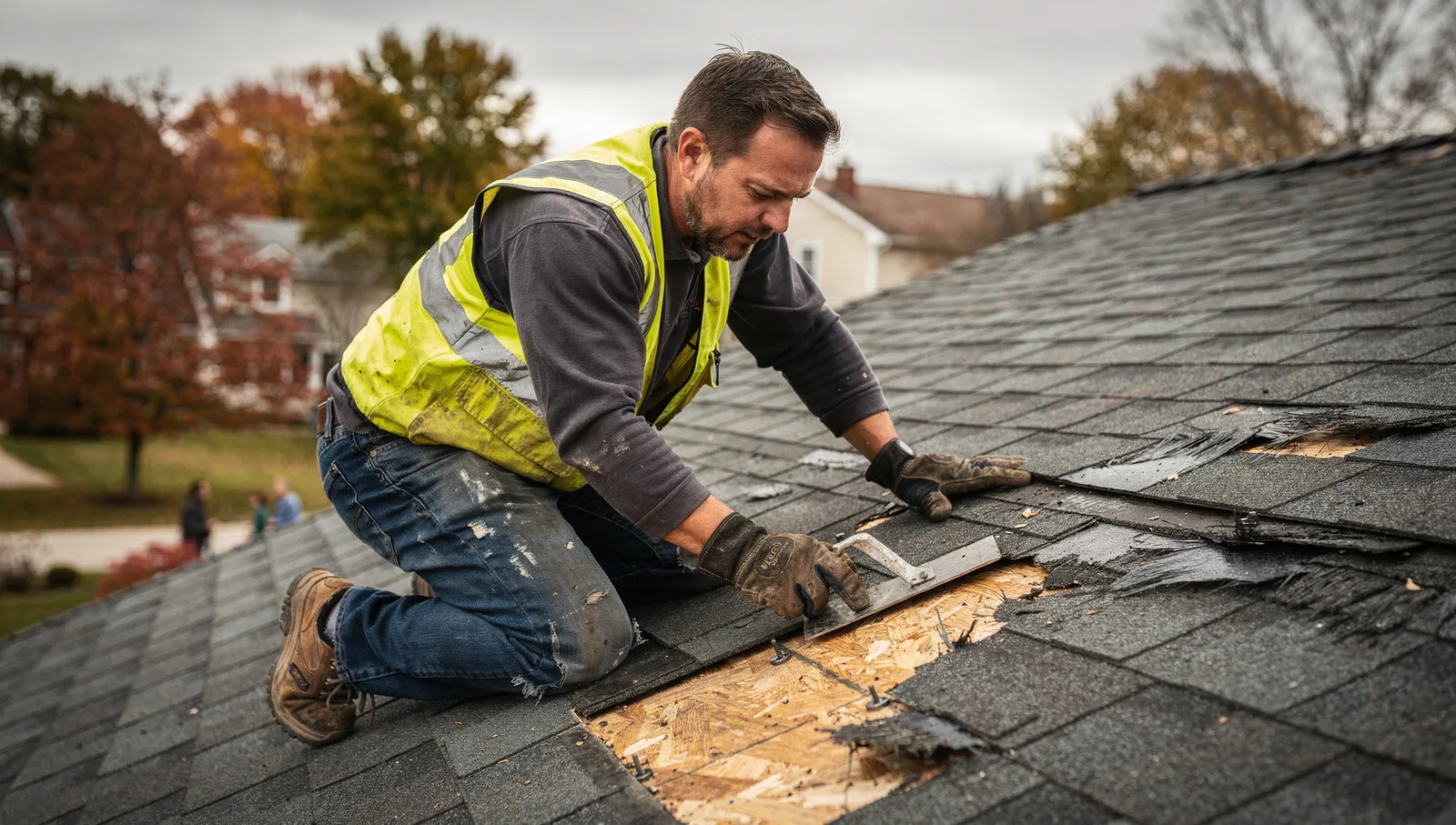
A storm hits your neighborhood, blows off a cluster of shingles. And suddenly everyone is quoting different numbers. A neighbor tells you that if you touch more than a quarter of the roof; state law forces a complete tear-off. An adjuster says something completely different.
The widespread myth of the "25% (grandrapidsmi.gov) rule" in Michigan residential roofing distracts homeowners from the real statutory triggers in Michigan Residential Code Chapter 9 (specifically Section R908.3). In reality, strict rules such as a two-layer cap, water-soaked roof decking, and mandatory ice barrier retrofits are what actually dictate when a minor repair legally forces a full-plane tear-off. Let us walk through how Michigan building authorities actually treat roof repairs, permits, and reroofing.
The 25% (cityofholland.com) Rule and Permit Triggers for Roof Work in Michigan#
The 25% (cityofholland.com) roof rule in Michigan is a local permit exemption threshold rather than a statewide mandate requiring full-slope replacement. According to the City of Holland, a building permit is not required for an ordinary roof repair involving less than 25% of the roof. However, projects that involve full reroofing or replacement do require a permit under those municipal guidelines.
While a 25% rule is often discussed in relation to roofing regulations, its application can vary locally across Michigan. In some Michigan municipalities, such as the City of Holland, a building permit is not required for a roof repair involving less than 25% of the roof. In Michigan residential work, local building departments enforce their own specific repair-versus-replacement triggers under the overarching state code framework.
When your repair stays below local thresholds, it is generally treated as an ordinary maintenance repair. In Holland, for example, staying under that 25% (cityofholland.com) mark lets you replace broken or missing shingles without submitting formal plans or paying permit fees. Once you exceed that line, or when you decide to do a full reroofing project, the municipality requires an official permit.
- Check repair size
- Verify local permit threshold
- Inspect deck and layers
- Pull permit or begin repair
Local permit thresholds also create distinct insurance claim implications when storms damage large sections of asphalt shingle coverings. When wind damage exceeds the local repair threshold, a jurisdiction like Holland classifies that scope outside ordinary repair exemptions (cityofholland.com). While an insurer might initially hope to pay for a tiny patch, crossing a local permit trigger means the work must satisfy formal municipal code standards. That permit requirement often brings other building code mandates into play, which can affect the overall scope of insurance-covered work.
Statewide Mandatory Tear-Off Conditions Under Michigan Residential Code R908.3#
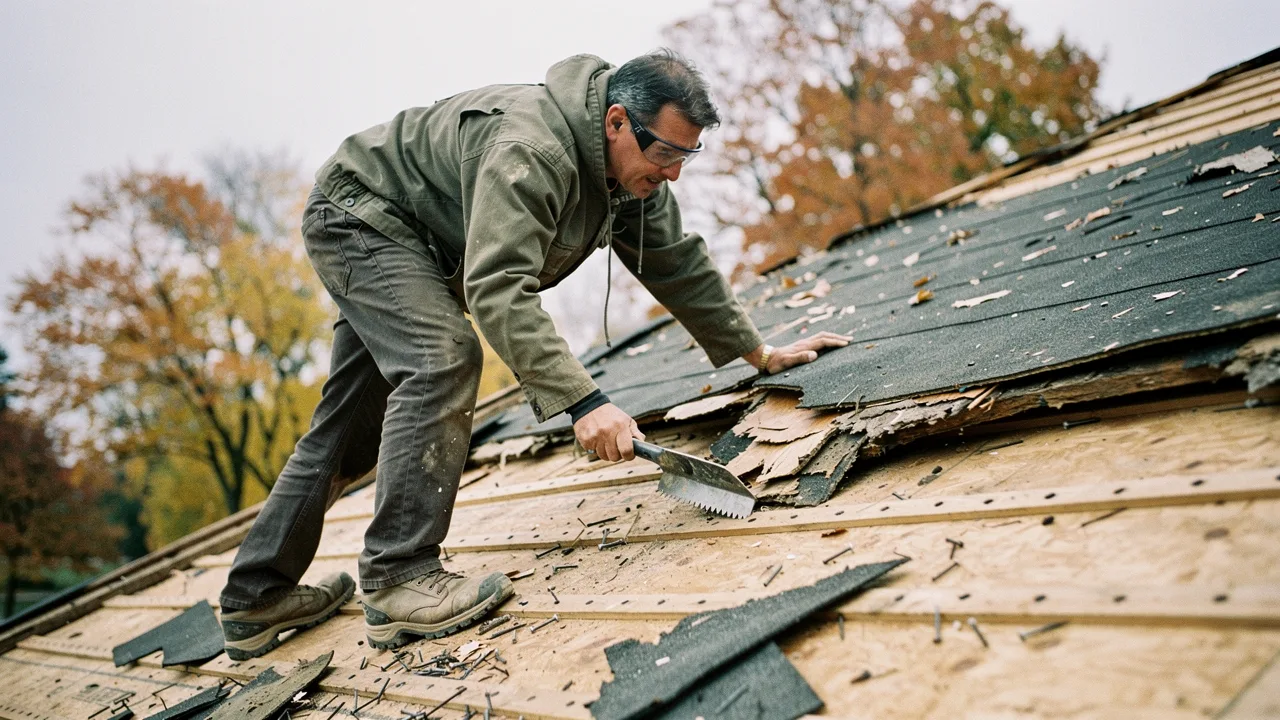
Under Section R908.3 of Chapter 9 of the Michigan Residential Code, installing a new roof covering over an existing one is strictly prohibited under three specific conditions (grandrapidsmi.gov). When any of these situations occur, the contractor must remove all existing layers down to the bare roof decking before installing any new material.
The state residential building code establishes clear conditions that forbid recovering an existing roof:
- Water damage or rot: New coverings cannot be installed where the existing roof or roof covering is water-soaked or deteriorated so as not to be an adequate base for additional roofing (grandrapidsmi.gov).
- Specific existing materials: All existing layers must be removed where the existing roof covering is wood shake, slate, clay, cement, or asbestos-cement tile.
- Maximum layer limits: A complete tear-off is mandatory where the roof already has two or more applications of any type of roof covering.
Total Existing Roof Layers Allowed Before Mandatory Tear-Off = 2
In the City of Manistee, adding an additional layer to an existing roof is allowed without a permit (up to two layers total), but removing/replacing the roof sheathing or decking requires pulling a building permit (manisteemi.gov). If your home already has two layers of shingles, adding a third is illegal everywhere in Michigan under Section R908.3 (grandrapidsmi.gov).
Under the Michigan Residential Code, mandatory tear-off conditions directly influence how homeowners and insurers address storm damage. If a home with two existing layers suffers minor wind damage to a single slope, a contractor cannot simply nail new shingles over that section. Because the code forbids a third application, that entire roof plane must undergo a complete tear-off (grandrapidsmi.gov). Stripping down to the deck exposes underlying plywood or boards, allowing the contractor to find and replace any soft, water-soaked wood that cannot provide a solid base.
Energy Code Provisions and Thermal Envelope Criteria for Reroofing#
Residential reroofing projects are largely exempt from additional energy code upgrades if they do not increase the structure's energy demand. Under Michigan Administrative Code R 408.30547c, reroofing is exempt from energy code provisions provided the energy use of the building is not increased and specific thermal envelope conditions are met (law.cornell.edu).
The building code sets two specific pathways for reroofing to remain exempt from energy code requirements:
- Unexposed sheathing and insulation: The roof is part of the thermal envelope, and neither the roof sheathing nor the roof insulation is exposed during work (law.cornell.edu).
- Unconditioned roof spaces: The roof is not part of the thermal envelope of the building.
The building's thermal envelope consists of the boundary planes that separate heated or cooled indoor living space from unconditioned air, such as an unvented attic assembly. If your roof sits over a standard ventilated, unconditioned attic space, the roof assembly is not part of the thermal envelope (law.cornell.edu). In that typical setup, pulling off old shingles does not trigger complex energy code mandates, as long as building energy use does not climb.
Even when a roof forms part of the thermal envelope, such as on a cathedral ceiling, an exemption applies if you simply recover or replace the shingles without uncovering the structural decking or disturbing the underlying insulation (law.cornell.edu). However, if rotted decking must be torn out, exposing the insulation underneath, the work crosses that threshold and may require addressing current energy standards.
Underlayment and Ice Barrier Specifications Across Michigan Municipalities#
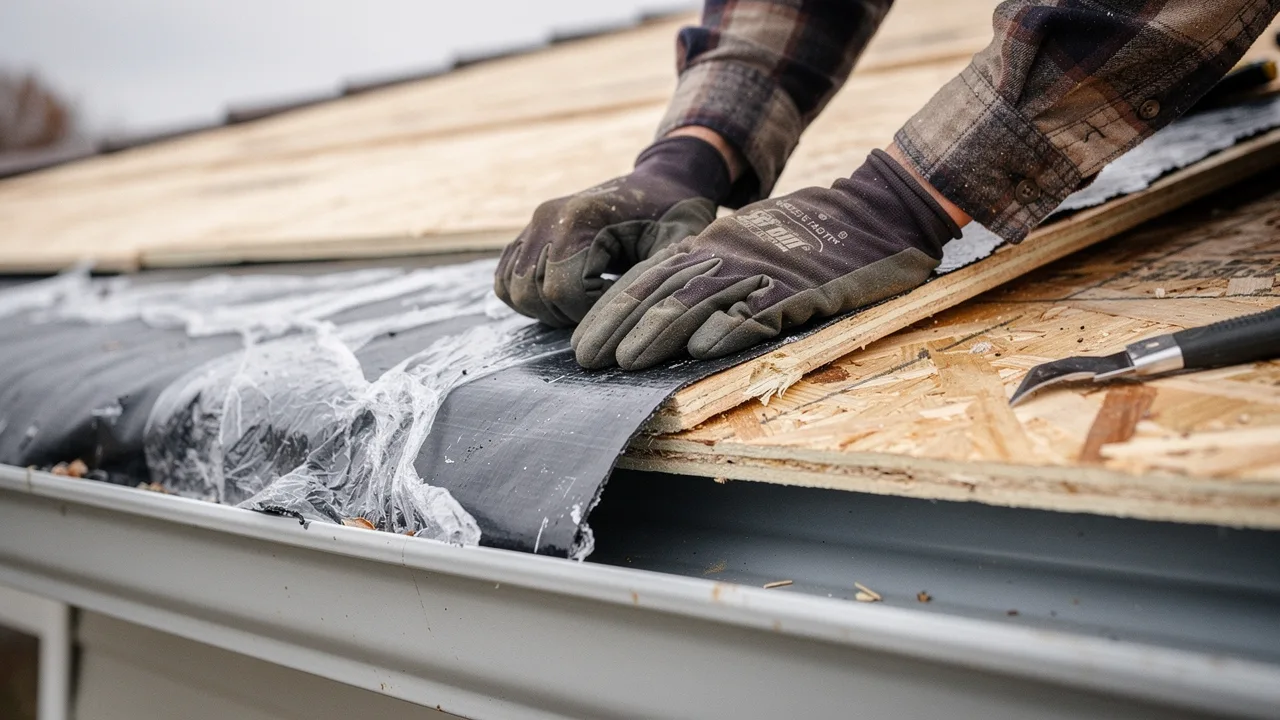
Whenever a roof undergoes full replacement in Michigan, the contractor must install code-compliant underlayment and ice protection. The Michigan Residential Code requires underlayment to be applied shingle fashion, parallel to and starting from the eaves, lapped at least 2 inches to shed moisture properly (grandrapidsmi.gov).
The residential building code specifies that this ice barrier must consist of at least two layers of underlayment cemented together or a self-adhering polymer-modified bitumen sheet. This membrane must extend from the lowest edges of all roof surfaces to a point at least 24 inches inside the exterior wall line of the building.
Local municipalities strictly enforce this protection to prevent Michigan freeze-thaw cycles from pushing water behind the siding and gutters:
- City of Detroit: Building code rules require 15-pound felt paper across the entire roof surface (detroitmi.gov). In addition, contractors must install an ice and water shield at the eaves that extends from the edge to a point at least 24 inches inside the exterior wall line.
- Grand Rapids: The Michigan Residential Code standard applies, requiring the 2-inch lapped underlayment and the ice barrier extending at least 24 inches inside the exterior wall line (grandrapidsmi.gov).
- Thomas Township: Residential roofing guidance requires ice and water shield to run from the lowest edges of all roof surfaces to a point at least 24 inches inside the interior wall line of the building (thomastwp.org).
Roof underlayment and ice barrier membranes are paired with metal edge trim, known as drip edge, to guide runoff cleanly away from roof decking and fascia boards. Roof pitch also plays a vital role in proper underlayment selection. Under the Michigan Residential Code, asphalt shingles must be fastened to solidly sheathed decks and are designed for roof slopes of two units vertical in 12 units horizontal, known as a 2:12 pitch, or greater (grandrapidsmi.gov).
Roofs with a 2:12 pitch can safely take shingles. But low slopes require modified underlayment techniques to prevent wind-driven rain from backing under the courses. Once winter ice dams or failing underlayment cause moisture to penetrate the living space, that is the point to bring in roofing help.
Structural Sheathing and Dead Load Limits for Roof Work#
Replacing damaged roof sheathing or adding heavy roofing materials can affect your home and trigger specific permit thresholds. In Antrim County, ordinary repairs to roof sheathing do not require a building permit if the work is less than 4 square feet per area (cms5.revize.com). Depending on local requirements, exceeding that small patch size may trigger permit mandates for sheathing work.
Permit-Free Sheathing Repair Limit in Antrim County = 4 sq ft per area
Townships also regulate how much physical weight can be added to an existing framing system without engineering review.
Silver Creek Township allows new roof coverings without a permit only if all of the following structural limits are met:
- No structural rehabilitation: No structural work is performed, including repairs to the roof sheathing or decking (silvercreektwpmi.gov).
- Area weight cap: The application of the new roof layer imposes no additional dead load increase greater than 3 pounds per square foot.
- Overall structural load cap: There is no increase to the structural elements of greater than 5% additional dead load.
If you plan to lay an architectural asphalt shingle over an existing layer, the weight must not exceed that 3 pounds per square foot threshold (silvercreektwpmi.gov). Furthermore, in areas like Silver Creek Township, installing new roof covering materials without a permit requires that there be no increase to structural elements of greater than 5% additional dead load. Likewise, local jurisdictions like Manistee mandate permits whenever sheathing or decking is replaced (as discussed above regarding layering limits), rather than treating deck work as exempt.
Inspection Scheduling and Related Exterior Code Exemptions#
Pulling a roofing permit triggers mandatory municipal inspections to verify that hidden components meet code before being covered up. Under Michigan administrative rules, any portion of construction that does not comply with the code must be corrected (law.cornell.edu). Furthermore, noncompliant work cannot be covered or concealed until authorized by the building official.
In the City of Detroit, roof replacement projects require obtaining two distinct inspections: the first at the tear-off stage, and the second for final sign-off (detroitmi.gov). To schedule an inspection with the Detroit Buildings Division, permit holders must call 24 hours in advance and no later than 3 p.m..
The initial tear-off inspection allows the municipal inspector to examine the decking and ensure that rotted wood has been addressed. Because administrative rules forbid covering unapproved work, roofing crews must coordinate these inspections carefully to avoid tearing off fresh shingles to expose the deck (law.cornell.edu).
At the same time, the building code provides practical exemptions for homeowners completing exterior updates. Under the 2015 Michigan Residential Code summary for single-family dwellings, work involving exterior surfaces of dwellings is exempt from carbon monoxide alarm requirements (otsegocountymi.gov). While general interior alterations or additions often trigger mandates to retrofit carbon monoxide alarms, exterior work such as replacing roofing or siding does not trigger this requirement.
Licensing Standards and Enforcement Penalties Under Act 230#
Michigan law treats roofing as a specialized trade that carries legal accountability for code compliance. Under Michigan Compiled Laws Section 339.2404, roofing is an authorized craft and trade requiring a residential maintenance and alteration contractor license (legislature.mi.gov). Unlicensed individuals are barred from pulling permits for hire, ensuring that contractors remain legally accountable to the state for following construction standards.
Enforcement of state construction standards is governed by Michigan Compiled Laws Section 125.1523, commonly known as Act 230 (legislature.mi.gov).
Under Section 125.1523, statutory violations carry significant legal consequences:
- Fines and jail time: A knowing violation of the code or permit conditions is punishable by a misdemeanor punishable by a fine of not more than $500.00 or imprisonment for not more than 90 days, or both.
- Stop construction orders: Failing to comply with a validly issued stop construction order constitutes a separate offense for each day of noncompliance.
- Municipal infractions: A governmental subdivision responsible for enforcing the Construction Code Act may designate statutory building code violations as municipal civil infractions and establish civil fines by ordinance.
If an unpermitted crew attempts to nail a third shingle layer over rotted decking, a building inspector can issue an immediate stop construction order. Each day the contractor ignores that order and continues working constitutes a distinct, punishable offense under state law (legislature.mi.gov).
Assessing Your Michigan Roof System#
Understanding building code rules helps you make informed choices about your home exterior.
If your roof is showing signs of age, take these concrete steps this week to evaluate your project:
- Count your existing layers: Check the roof edge at the gutters. If you see two layers of shingles, state code mandates that any future reroofing must be a full tear-off (grandrapidsmi.gov).
- Check the attic wood: Head into the attic space with a flashlight after a heavy rain. Look for dark stains, delaminating plywood, or soft roof decking that would prevent shingles from securing firmly.
- Verify the roof slope: Ensure your roof meets the minimum 2:12 pitch for standard asphalt shingles.
- Confirm ice barrier layout: Check your eaves to confirm previous installations brought ice barriers at least 24 inches inside the exterior wall plane.
A reliable roof requires treating shingles, ice barriers, proper ventilation, and sturdy decking as a single protective system. Homeowners in Northville, Novi, and Plymouth can rely on Horizon Roofing & Construction to navigate these municipal codes and complete an honest assessment of their home exterior.
| Jurisdiction | Permit-Exempt Work Scope | Permit Trigger / Restriction | Decking & Sheathing Threshold |
|---|---|---|---|
| City of Holland | Roof repairs involving less than 25% of the roof | Re-roofing (new and replacement) or repairs of 25% or more | Structural repairs require a permit |
| City of Manistee | Adding a 2nd layer (2 layers total max) or surface replacement only | Adding more than 2 layers or altering structural supports | Replacement of roof sheathing or decking requires a permit |
| Antrim County | Ordinary reroofing on buildings with fewer than 2 existing layers | Roofs with 2 or more existing covering layers | Sheathing repairs exempt only if under 4 sq ft per area |
| Code Provision / Feature | Statewide MRC Standard | Detroit Requirement | Thomas Township Requirement |
|---|---|---|---|
| Maximum Allowable Covering Layers | 2 layers total (mandatory tear-off for 2 or more existing layers) | 2 layers total (tear-off required if 2 or more layers exist) | Not specified locally (follows MRC statewide limit of 2 layers) |
| Ice Barrier Inward Eave Extension | At least 24 inches inside the exterior wall line | At least 24 inches inside the exterior wall line | At least 24 inches inside the interior wall line |
| Required Municipal Inspections | Successive stages determined by enforcing building official | Two mandatory inspections: tear-off inspection and final inspection | Inspections as required by local building department permit |
Michigan Roof Repair vs. Permit & Replacement Trigger Evaluator
Calculates the percentage of damaged or repaired roof area against total roof area to evaluate the local 25% permit exemption threshold and statutory Michigan Residential Code (MRC R908.3) tear-off triggers like exceeding 2 layers or rotted decking.
Repair Proportion of Roof:
Exceeds 25% Permit Exemption (1 = Yes, 0 = No):
Full Permit or Tear-Off Triggered (1 = Yes, 0 = No):
Frequently Asked Questions
What is the 25% rule for roofing in Michigan?
In Michigan, a 25% rule is not a statewide mandatory replacement mandate. In municipalities like Holland, it functions as a permit exemption threshold: roof repairs involving less than 25% of the roof do not require a permit.
What is the minimum pitch for a shingle roof in Michigan?
Under the Michigan Residential Code, asphalt shingles require a minimum slope of two units vertical in 12 units horizontal (a 2:12 pitch) or greater, fastened to solidly sheathed decks.
Can shingles go on a 2-12 pitch roof?
Yes. Under Michigan Residential Code Section R905.2.2. Asphalt shingles can be installed on roof slopes of 2:12 (two units vertical in 12 units horizontal) or greater when fastened to solidly sheathed decks.
When does Michigan building code require a complete roof tear-off instead of a re-cover?
Under Michigan Residential Code R908.3, tear-off is mandatory if the roof has two or more existing layers, is water-soaked or deteriorated, or consists of wood shake, slate, clay, cement, or asbestos-cement tile.
Disclaimer
This content is general information about roofing and home-exterior work and is not a substitute for an on-site inspection. Contact Horizon Roofing & Construction for advice specific to your home.
Sources
- Roof Replacement Requirements - detroitmi.gov
- Roof Assemblies (Chapter 9 Michigan Residential Code) - grandrapidsmi.gov (2026-08-18)
- Mich. Admin. Code R. 408.30547c - [Rescinded effective 8/29/2025 ... - law.cornell.edu (2025-08-29)
- [PDF] Michigan Construction Code Public Act 230 of 1972 Residential ... - otsegocountymi.gov (2026-08-15)
- Building Ordinary Repairs Exempt from Permit - manisteemi.gov
- Silver Creek Township Construction Code Interpretation - silvercreektwpmi.gov (2024-08-19)
- MCL - Section 339.2404 - Michigan Legislature - legislature.mi.gov
- Mich. Admin. Code R. 408.30571 - Violation penalties | State Regulations | US Law | LII / Legal Information Institute - law.cornell.edu
- MCL - Section 125.1523 - Michigan Legislature - legislature.mi.gov
- Antrim County Construction Code Policy Regarding Re-roofing & Re-Sinding Adopted: July 3, 2019 - cms5.revize.com (2019-07-03)
- Building Permit Requirements | Holland, MI - cityofholland.com
- A GUIDE TO - thomastwp.org